
What is Cloud Technology?
It is an internet based off-site data storage and retrieval facility with add on facilities of providing data computing services and resources, generally for multiple clients. This type of a Cloud is called a Public Cloud. There are Clouds serving only a single organisation (Enterprise Clouds), called a Private Cloud. However, generally the Clouds are owned and operated by third party Cloud services providers for multiple clients. A modern man uses the Cloud Technology everyday but remains unaware of its use. If you are using Emails, Social Media, Video streaming services, IoTs, Weather App, Web Searches, etc, you are using cloud technology. The Clouds not only provides services for storage of data but it also provides other computing facilities like Software as a Service (SaaS), Platform as a Service (PaaS), etc.
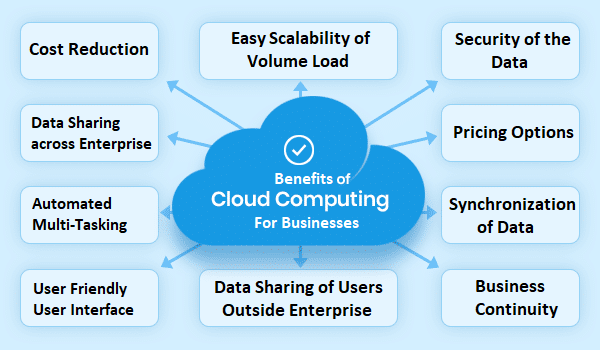
Benefits of the Cloud Technology:
[1] Cost Reduction
To store the data safely, businesses need a Server Room. Setting up a Server Room is costly as it needs space, servers, air conditioning, fire safety equipments, CCTV Cameras, physical access control measures, etc. Disaster Recovery arrangement is also required. The businesses can obviate all these cost and also hassles if the services of Cloud Technology are availed.
[2] Sharing of the Data across the Enterprise
The data can be shared seamlessly on realtime basis by all the users irrespective of the location of the users, time of the access and the device used to access the data. What a great boon in the era of “Work Form Home”.
[3] Sharing of the Data with the Users outside the Enterprise
The data can also be shared in a secured and staggered manner with the users outside the enterprise e.g. customers, suppliers, buyers, investors, etc. This saves lots of time to provide services to customers and plugs the leakages in communication. Online shopping is a good example of availing benefits by this functionality.
[4] Automated Multi-tasking
Local hard-disk or on-site server are fast but when facing multi-tasking by a user or multiple users, they fall short of expectations of users regarding the speed. Given the high capacity of the Cloud for handling automated data flow coupled with speed of the internet, speed satisfies the expectations of multiple users at a time.
[5] User Friendly User Interface
Setting up and maintaining the Cloud services as such are ticklish jobs, even for an IT expert. However, for the user, it is very easy to upload or download the files as the interface is user friendly.
[6] Device Agnostic System
The Cloud works seamlessly with multiple types of devices (PC, laptop, tablet, mobile, etc) at the user end.
[7] Easy Scalability of Volume Load
As the Clouds have massive capacity to handle voluminous data, the CSPs can satisfy the storage need of the client on demand. This convenience cannot be expected if a business has its own data storage facility. As the CSPs have multiple clients, the increase and decrees in the demand stands counter-balanced so their capacity remains optimally utilised benefiting the clients in terms of pricing.
[8] Pricing Options
The CSPs offer various pricing options based on Time Used, Per User, Data Volume and permutations based on these factors (Hybrid Option). These options help the clients to choose the right pricing model and save the cost.
[9] Security of the Data
When connected via internet, safety of data remains the top most concern for the clients and it is more so when the data is uploaded in the servers owned by the third party at a faraway location, mostly unknown to the clients. This concern is well addressed by various physical and digital measures (firewall, encryption, back-ups at other location, etc) by the CSPs. The level of security is higher than what is available at in-house data centre/ server room. As the CSPs are big corporates like Google Cloud, IBM, Amazon, Microsoft Azure, Alibaba etc they can afford large sum for the purpose which individual could not afford. Further, it is not all about money but it is also about having talented manpower in the team.
[10] Business Continuity
Data could be lost due to various reasons like technical failure of the hardware, virus, sabotage, piracy, natural hazards, fire, short-circuit, etc. Business can face tough time to run the shop in a normal way. The chances of such untoward incident will be practically nil in view of the multi-layer security measure deployed by the CSPs. If the businesses avail the Cloud services, it is also a sound alternative to Disaster Recovery measure.
[11] Synchronization of Data
Cloud vendors provide the synchronization functionality. With this feature, user can sync the cloud storage data with other devices, seamlessly.
[12] Standardisation
Though every user of a computer follows standard procedure and dots the I’s and cuts the T’s, the output/ deliverables are not so standard for variety of reasons. The use of Cloud helps to standardise the input and generate more standardised output/ deliverables.
Disadvantages of the Cloud Technology:
[1] Dependency on Internet
Internet is the mainstay of Cloud Technology. In data technology, the internet has made the geography irrelevant but if the same internet is not available or slow, the user is hamstrung.
[2] Data Security and Privacy
Though the Cloud Services are well equipped to maintain the data security, there are incidents of hacking. Depending upon the law of the land, an authority of a Sovereign Government can compel to divulge the data under given circumstances.
[3] Downtime
If the Cloud service is facing a power outage, a DoS (Denial of Services) attack buy a digital rogue, a technical glitch, a shutdown for maintenance, your own data will not be available till the problem is fixed.
Origin of the name Cloud:
The cloud symbol was used to represent networks of computing equipment in the ARPANET (Advanced Research Project Agency Network, USA) as early as 1977. As such it is a metaphor, having nothing to do with clouds in the sky.
How it works:
Before advent of the Cloud Technology, organisations
used to store their data in removable hard-disk or Servers. Servers could be
on-site or off-site. The Cloud Service Providers (CSPs) setup the server
facility with massive capacity to store the data for the clients. This facility
could be at one location or distributed across the globe, close to demand
centres.
Future of the Cloud Technology:
The volume at which the data is generated every day is so massive that the adjectives like exponential and astronomical are poor to give the correct picture of the situation. The digital yardstick of Byte (Kilobyte to Yottabyte) is also small to measure the volume. The need and greed for data of businesses are increasing. Data has become a precious commodity in the modern world. Managing and manipulating data for commerce, communication, eGovernance, and entertainment are at the forefront of computing. Under such circumstances a question arises in the mind: What is the future of the Cloud Technology in the world of computing. The answer is: The Cloud Technology is the future of computing.
If needed any consultation, please do not hesitate to contact us
at 8448444245 or info@gujaratinfotech.com for any kind of requirement
related to Cloud Services from Amazon and Microsoft Azure" or Visit - www.gujaratinfotech.com
=0=0=0=
(The comments of the readers are
welcome at gnpatel@gujaratinfotech.com)

