Showing posts with label business. Show all posts

Sunday, March 7, 2021

Benefits of Cloud Technology for Businesses


What is Cloud Technology?

It is an internet based off-site data storage and retrieval facility with add on facilities of providing data computing services and resources, generally for multiple clients. This type of a Cloud is called a Public Cloud. There are Clouds serving only a single organisation (Enterprise Clouds), called a Private Cloud. However, generally the Clouds are owned and operated by third party Cloud services providers for multiple clients. A modern man uses the Cloud Technology everyday but remains unaware of its use. If you are using Emails, Social Media, Video streaming services, IoTs, Weather App, Web Searches, etc, you are using cloud technology. The Clouds not only provides services for storage of data but it also provides other computing facilities like Software as a Service (SaaS), Platform as a Service (PaaS), etc.

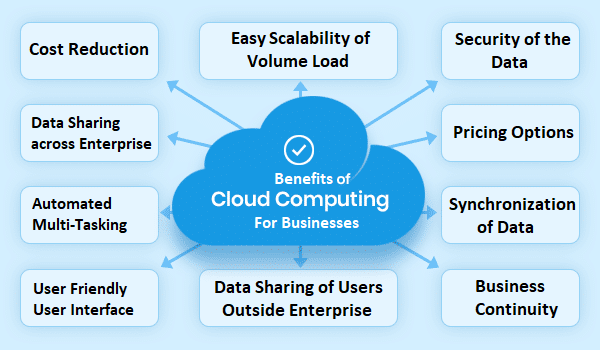
Benefits of the Cloud Technology:

[1] Cost Reduction

To store the data safely, businesses need a Server Room. Setting up a Server Room is costly as it needs space, servers, air conditioning, fire safety equipments, CCTV Cameras, physical access control measures, etc. Disaster Recovery arrangement is also required. The businesses can obviate all these cost and also hassles if the services of Cloud Technology are availed.

[2] Sharing of the Data across the Enterprise

The data can be shared seamlessly on realtime basis by all the users irrespective of the location of the users, time of the access and the device used to access the data. What a great boon in the era of “Work Form Home”.

[3] Sharing of the Data with the Users outside the Enterprise

The data can also be shared in a secured and staggered manner with the users outside the enterprise e.g. customers, suppliers, buyers, investors, etc. This saves lots of time to provide services to customers and plugs the leakages in communication. Online shopping is a good example of availing benefits by this functionality.

[4] Automated Multi-tasking

Local hard-disk or on-site server are fast but when facing multi-tasking by a user or multiple users, they fall short of expectations of users regarding the speed. Given the high capacity of the Cloud for handling automated data flow coupled with speed of the internet, speed satisfies the expectations of multiple users at a time.

[5] User Friendly User Interface

Setting up and maintaining the Cloud services as such are ticklish jobs, even for an IT expert. However, for the user, it is very easy to upload or download the files as the interface is user friendly.

[6] Device Agnostic System

The Cloud works seamlessly with multiple types of devices (PC, laptop, tablet, mobile, etc) at the user end.

[7] Easy Scalability of Volume Load

As the Clouds have massive capacity to handle voluminous data, the CSPs can satisfy the storage need of the client on demand. This convenience cannot be expected if a business has its own data storage facility. As the CSPs have multiple clients, the increase and decrees in the demand stands counter-balanced so their capacity remains optimally utilised benefiting the clients in terms of pricing.

[8] Pricing Options

The CSPs offer various pricing options based on Time Used, Per User, Data Volume and permutations based on these factors (Hybrid Option). These options help the clients to choose the right pricing model and save the cost.

[9] Security of the Data

When connected via internet, safety of data remains the top most concern for the clients and it is more so when the data is uploaded in the servers owned by the third party at a faraway location, mostly unknown to the clients. This concern is well addressed by various physical and digital measures (firewall, encryption, back-ups at other location, etc) by the CSPs. The level of security is higher than what is available at in-house data centre/ server room. As the CSPs are big corporates like Google Cloud, IBM, Amazon, Microsoft Azure, Alibaba etc they can afford large sum for the purpose which individual could not afford. Further, it is not all about money but it is also about having talented manpower in the team.

[10] Business Continuity

Data could be lost due to various reasons like technical failure of the hardware, virus, sabotage, piracy, natural hazards, fire, short-circuit, etc. Business can face tough time to run the shop in a normal way. The chances of such untoward incident will be practically nil in view of the multi-layer security measure deployed by the CSPs. If the businesses avail the Cloud services, it is also a sound alternative to Disaster Recovery measure.

[11] Synchronization of Data

Cloud vendors provide the synchronization functionality. With this feature, user can sync the cloud storage data with other devices, seamlessly.

[12] Standardisation

Though every user of a computer follows standard procedure and dots the  I’s and cuts the T’s, the output/ deliverables are not so standard for variety of reasons. The use of Cloud helps to standardise the input and generate more standardised output/ deliverables.

Disadvantages of the Cloud Technology:

[1] Dependency on Internet

Internet is the mainstay of Cloud Technology. In data technology, the internet has made the geography irrelevant but if the same internet is not available or slow, the user is hamstrung.

[2] Data Security and Privacy

Though the Cloud Services are well equipped to maintain the data security, there are incidents of hacking. Depending upon the law of the land, an authority of a Sovereign Government can compel to divulge the data under given circumstances.

[3] Downtime

If the Cloud service is facing a power outage, a DoS (Denial of Services) attack buy a digital rogue, a technical glitch, a shutdown for maintenance, your own data will not be available till the problem is fixed.

Origin of the name Cloud:

The cloud symbol was used to represent networks of computing equipment in the ARPANET (Advanced Research Project Agency Network, USA) as early as 1977. As such it is a metaphor, having nothing to do with clouds in the sky.

How it works:

Before advent of the Cloud Technology, organisations used to store their data in removable hard-disk or Servers. Servers could be on-site or off-site. The Cloud Service Providers (CSPs) setup the server facility with massive capacity to store the data for the clients. This facility could be at one location or distributed across the globe, close to demand centres.

Future of the Cloud Technology:

The volume at which the data is generated every day is so massive that the adjectives like exponential and astronomical are poor to give the correct picture of the situation. The digital yardstick of Byte (Kilobyte to Yottabyte) is also small to measure the volume. The need and greed for data of businesses are increasing. Data has become a precious commodity in the modern world. Managing and manipulating data for commerce, communication, eGovernance, and entertainment are at the forefront of computing. Under such circumstances a question arises in the mind: What is the future of the Cloud Technology in the world of computing. The answer is: The Cloud Technology is the future of computing. 

If needed any consultation, please do not hesitate to contact us at 8448444245 or info@gujaratinfotech.com for any kind of requirement related  to Cloud Services from Amazon and Microsoft Azure" or Visit - www.gujaratinfotech.com

 =0=0=0=

(The comments of the readers are welcome at gnpatel@gujaratinfotech.com)

Monday, September 28, 2020

How to Open a Bank CSP (Customer Service Point)?

To Open a Bank CSP / Customer Service Point (Centre) or to become a CSP / Bank Mitra / BCA / VLE (Village Level Entrepreneur) is a sound career option for the youth. Many youths are aspiring for this work and hence many so called “agents” have set up their network to take undue advantage of these gullible youths. Not only that, even amongst the authorized CBC companies, there may be some companies whose dealing with the aspiring candidates may not be transparent and support may be poor once you have joined as a BCA. Hence, it is utmost important to select a reputed CBC Company with a strong track record. If any person representing him/her as an authorized agent or employee of the CBC, it is always advisable to cross-check with the Head Office of the company about the credentials of such person. You can also apply online on the website of the Company or submit the application by email/post. Most importantly, any payment to be made in this connection, must be made by A/c Payee cheque drawn in favour of the CBC Company.

Eligibility criterion to become a BCA/CSP/Bank Mitra/VLE:

·        Age: Applicant must be at least 18 years of age.

·      Minimum educational qualification - 10th level examination passed from a recognized board.

·        Should have a valid Aadhaar and PAN number.

·        Must know the local language

·        Preference will be given to a local person

·        Must be computer literate

 Documents required with application:

 .   Application form duly filled in and signed by the candidate

  Two passport size photos

.   Cancelled Cheque without signature

Self-Attested True Copy of:

-         Education certificate (Highest Education Qualification)

-         Proof of residence (Aadhar Card)

-         Photo ID Proof (Aadhar Card)

-         PAN Card

(the original is also to be produced only for verification by CBC Company)

Following documents to be produced as and when advised by the CBC Company:

-       Clean Police Report

-    The photograph of the place where the kiosk is to be set up (one photo from outside and one from the inside of the place). This is not required under tablet model.

-     Ownership document / Rent Agreement of the place for the kiosk This is not required under tablet model.

 Other pre-conditions:

ü     The branch with which the applicant wants to be linked must be willing to engage a BCA in the locality from where the applicant wants to operate.

ü    Must have necessary resources for purchasing required computer peripherals / tablet / internet connection / suitable space for setting up the kiosk / furniture (as per the specification / configuration fixed by the bank. Space / furniture may not be insisted upon under tablet model).

ü   The candidate has to pass the IIBF (Indian Institute of Banking and Finance, Mumbai) online certificate exam within specified period after the engagement as a BCA.

ü    Must have a bank account with Cheque Book facility

ü    Must be able to obtain clean Police Report from the Police Station having jurisdiction over the residential area of the applicant

ü   Must not be working as a BCA of any other bank

ü    If worked as a BCA of any bank in the past, must give acceptable reason why he ceased to be a BCA. This fact must be mentioned in the Application Form.

ü    Must have clean CIBIL (Credit Rating Agency) Report.

 How the application moves further:

As stated above, the CBC Company plays a vital role in engaging the BCA. The CBC has information about the branches which want to engage new BCA. Some time, CBC is looking for new BCA to fill up these vacancies.

After receipt (online or physical) of the application, the CBC will verify the documents, visit the applicant and the proposed place. CBC will also make discreet inquiry about the reputation of the applicant. CBC will introduce the applicant to the Branch Manager, who will also interview the applicant. The CBC will submit the documents to the Branch. If the Branch Manager is satisfied about the eligibility criterion and capability of the candidate, he will submit the proposal to higher authority for generation of BCA Code. After receipt of the Code, the CBC company will issue Authority Letter and ID Card to the applicant to work as a BCA.  CBC Company will also give training, product knowledge, Welcome Kit, etc.

With the nationalization of India’s 14 major banks in 1969, the seed of Social Banking (the term Financial Inclusion was not coined by then) was sown. The nationalization of banks in India is a glorious example of adaptation by commercial business houses from profit to public service without losing the commercial viability of the business. As usual to public sector, various committees have been appointed from time to time to achieve the objectives of nationalization. Khan Committee (2004) recommended to implement Business Facilitator (BF) model (for delivering non-financial banking services) and Business Correspondent (BC) model (for delivering financial banking services). As a result, the concept of Financial Inclusion was first introduced in India in 2005 by the Reserve Bank of India. The objectives of Financial Inclusion are to provide basic no-frills banking account for making and receiving payments. Later, Dr Rangrajan Committee (2006) went further and recommended to exploit BC model not only for delivering banking services but entire gamut of financial services (insurance, pension plans, investment, Financial Literacy, etc)  to financially excluded, vulnerable section of the society under Financial Inclusion Project and bring them into mainstream economy.

What is Financial Inclusion:

Financial Inclusion is the process of delivering appropriate financial products and services needed by weaker sections of the society at an affordable cost in a fair and transparent manner.

The present status:

There are 10 lakh BCAs working under the project as on March 2019 and delivering following financial services to customers in their vicinity:

Though the features of the Project differ from bank to bank to some extent, they can be generally described as under:

Services offered through BC Model are:

a.   Opening of Saving Banks (PMJDY)/ Fixed Deposit /PPF/ Recurring account.
b.  Cash Deposit and Cash Withdrawal.
d.   Fund Transfer from one centre to another centre
e.   Balance Inquiry.
f.   Mini Statement.

g.   Linking of Aadhar Card and Mobile Number

h.   Payment of utility bills

i.   Opening Insurance Accounts (Atal Pension Yojana, PMJSY, PMJJY, etc)

j.  Payment of amount credited by Govt under PMGKY, PMKSNY, MGNREGA, Cooking Gas Subsidy, other DBT, Student Scholarship, etc)

k. Canvassing the loan a/cs (Agriculture - KCC, Term Loans, Gold Loans. Non Agriculture – Housing Loans, Car Loans, Gold Loans, etc)

l.  Recovery in overdue /NPA a/cs as advised by the branch

How the Project works:

The most important link in the project is the Corporate Business Correspondent (CBC) which is generally a reputed company. The CBC is selected after a strict due diligence process considering the technical and financial capabilities and reputation of the company. The bank also obtains Security Deposit and /or Bank Guarantee from the entity. The CBC is accountable for all the acts and omissions committed by the BC engaged under it as per the Agreement between the bank and the CBC. This provision is very important for instilling the confidence amongst the customers while transacting the banking transactions with the BCA and maintain the integrity of the transaction from end-to-end.  The CBC is getting commission on the work done by the BC, which is shared with the BC as fixed by the bank. The scope of dispute about the commission payable to BCA is rare as it is calculated as per the rate fixed by the bank. The bank will credit the shar of BCA commission first and then credit the Company’s share through special accounting process.

Gujarat Infotech Ltd is working as a CBC Company since 2012 of various banks and has good reputation amongst banks, BCAs and customers. At present hundreds of BCs are working under our Company. 

To become CSP Bank Mitra visit our website www.gujaratinfotech.com 

To apply online, contact us at 8448444245 for more information. A small step in right direction will change your future.

=0=0=